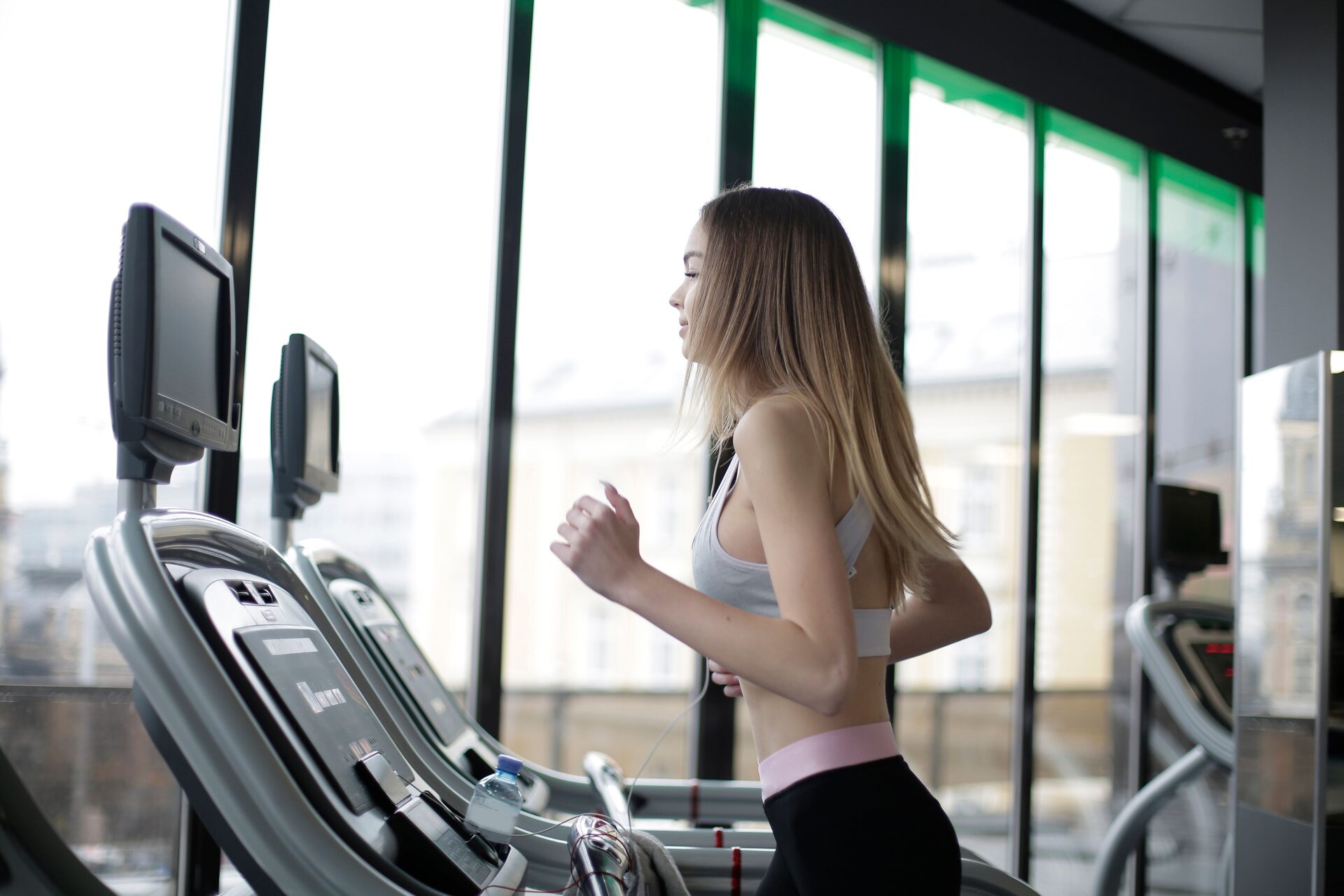
Is the belt really moving at the displayed speed?
On average, close to it. Across four treadmills tested under a runner's load, including a consumer machine, average belt speed stayed between about 98 and 103% of the set speed. The folk claim that treadmill displays are wildly off overstates what has been measured.
The real error lives inside each stride. At foot strike your body brakes the belt, which slows by 2 to 10% before it recovers. On a worn machine that dip reached 12 to 25%, and it grows with heavier runners. The display shows none of it.
What nobody has measured is the machine in your gym. No published survey of display error across gym fleets exists, so any percentage you've seen quoted for how fast treadmills read didn't come from one.
Why is your watch showing a different pace than the treadmill?
Because the watch isn't reading the belt. Indoors, with no GPS, it estimates pace from the accelerometer at your wrist, and the vendors say so themselves. Apple's watch learns your stride length from outdoor GPS runs and applies it indoors. Garmin states that accuracy improves after a few outdoor runs and that holding the handrails reduces it. Polar states plainly that wrist accelerometer readings are not as accurate as GPS.
Garmin's calibration procedure is to run at least 2.4 km and then enter the distance the treadmill displayed. That tunes one estimate against another; there is no measurement in the loop.
The best published test is from 2017: across 11 wearables tested, distance error on a calibrated treadmill reached 50%. No study since has tested current watches against belt speed. Neither the belt's number nor the watch's is a measurement of you, so a disagreement between them has no referee.
Why does running on a treadmill feel harder than outside?
Mostly at faster paces; at easy paces the belt usually feels easier. At the same speed on a flat belt, heart rate and perceived effort run higher than outdoor running at faster easy or moderate speeds and lower at slower ones. Heart rate reads about the same near 13.6 km/h. Both complaints about the treadmill are right, at different speeds.
Your sense of the pace itself is the least reliable signal of the three. Runners blinded to the display and asked to reproduce an outdoor pace they had just run chose belt speeds roughly a third slower. One study measured 2.25 m/s chosen against an actual 3.65; another, 2.73 against 3.99. On the display, that first pair is 8.1 km/h dialed in to match 13.1. The likeliest explanation is visual: nothing in your field of view moves past you, so the belt reads faster than it is.
The same physiology answers the reverse complaint, treadmill paces faster than you hold outdoors. At easy speeds the same pace costs less indoors, in heart rate and in felt effort, so the pace you settle at by feel drifts up.
Should you run at 1% incline on the treadmill?
At easy paces it doesn't matter; 0 and 1% are both fine. The 1% rule is a convention under live dispute, and its own source says the correction depends on speed.
The rule comes from a 1996 study of nine trained runners that tested nothing slower than 10.5 km/h, about 5:42 per km. Even its authors put the correction at about 0.5% at slow speeds and about 2% at 18 km/h and faster. Everything measured since finds no cost difference at everyday training speeds, whether the belt is flat or at 1%. The incline matters only near maximal effort, at 80% of VO₂max and above, where a flat belt costs less than the road. Newer studies still disagree in both directions.
The correction exists to stand in for the air resistance you'd meet outdoors. A HYROX race is an indoor event, run without wind either way. Training outside and racing indoors crosses the same boundary in the other direction.
How do you do HYROX pace work on a treadmill?
Set the belt from your target split with one piece of arithmetic, or run the session on heart rate instead. The belt speaks km/h and your split speaks minutes per km, and dividing 60 by either number gives the other. A display reading 12.0 km/h is a 5:00 per km split, because 60 ÷ 12.0 = 5.0. Seconds convert as fractions of a minute: 30 seconds is 0.5.
The 12.0 is an example display number. Your own split comes out of your goal time. Here's the derivation:
 What running intervals should you do for HYROX?
Six 1 km reps at your target average race split, run on fresh legs, with 90 seconds of walking rest between reps.
What running intervals should you do for HYROX?
Six 1 km reps at your target average race split, run on fresh legs, with 90 seconds of walking rest between reps.
Heart rate is the one signal in the room measured on your body instead of by the machine. At the same easy or moderate speed, treadmill heart rate sits within a few BPM of outdoor running. Effort transfers across surfaces even when the pace numbers argue, so the zone that governs an easy run outside governs the same run on the belt. It's the same signal that governs running under station fatigue.
If heart rate jumps in a way the effort doesn't explain, check the watch before you check yourself.
RunBeat coaches that session by voice, with nothing taken from the belt's display:
 Zone Training in RunBeat
RunBeat tells you to speed up or slow down to stay in zone, right over your music or podcast.
Zone Training in RunBeat
RunBeat tells you to speed up or slow down to stay in zone, right over your music or podcast.
Sources
- Willwacher S, Fischer KM, Rodriguez Guerrero N, et al. A new method for measuring treadmill belt velocity fluctuations: effects of treadmill type, body mass and locomotion speed. Scientific Reports. 2021;11:2244. doi:10.1038/s41598-021-81951-9. Four treadmills under load, including a consumer Sole F85. Source for the 98 to 103% average band and the within-stride slowdowns, including the worn machine's 12 to 25%. The paper attributes the worn machine's extremes to belt wear and control settings. Tielke 2019 and Savelberg 1998 corroborate the within-stride slowdown; both read at abstract level, no figure taken. No peer-reviewed survey of display error across gym fleets exists, which is why this page states that gap instead of a fleet percentage.
- Wahl Y, Düking P, Droszez A, Wahl P, Mester J. Criterion-validity of commercially available physical activity tracker to estimate step count, covered distance and energy expenditure during sports conditions. Frontiers in Physiology. 2017;8:725. doi:10.3389/fphys.2017.00725. 11 wearables tested; one was excluded from analysis for missing data. Source for the distance error reaching 50% against a calibrated treadmill (ICC 0.0 to 0.2). 2017 devices, so the pattern transfers and the numbers attach to no current product. No study since tests current watches against belt speed.
- Apple Support, Calibrating your Apple Watch (HT204516). Read August 28, 2026. Source for stride-length calibration learned from outdoor GPS runs.
- Garmin owner's manuals, treadmill activity and calibration. Read August 28, 2026. Source for accelerometer-estimated indoor pace, the handrail note, and the calibration procedure of entering the belt's displayed distance after at least 2.4 km.
- Polar support pages. Read August 28, 2026. Source for the statement that wrist accelerometer readings are not as accurate as GPS.
- Jones AM, Doust JH. A 1% treadmill grade most accurately reflects the energetic cost of outdoor running. Journal of Sports Sciences. 1996;14(4):321–327. doi:10.1080/02640419608727717. Nine trained runners at 10.5 to 18.0 km/h. The 0.5% and 2% figures are the authors' own suggestions from regression trends, partly outside their tested speeds, not tested conditions.
- Miller JR, Van Hooren B, Bishop C, Buckley JD, Willy RW, Fuller JT. A systematic review and meta-analysis of crossover studies comparing physiological, perceptual and performance measures between treadmill and overground running. Sports Medicine. 2019;49:763–782. doi:10.1007/s40279-019-01087-9. Source for the pooled cost findings at 0% and 1%, the near-maximal reduction of 3.12 mL/kg/min at or above 80% VO₂max, the speed-dependent heart rate and effort differences, and the 13.6 km/h similarity estimate, which is a meta-regression estimate, not a tested speed.
- Mooses M, et al. Better economy in field running than on the treadmill: evidence from high-level distance runners. Biology of Sport. 2015;32(2):155–159. 13 high-level runners; found overground running cheaper than a 1% treadmill. One direction of the current dispute.
- Shahidi et al. PLoS One. 2026 (PMC13480612). Found overground running costlier than a 1% treadmill across intensities. The other direction of the current dispute.
- Kong PW, Candelaria NG, Tomaka J. Perception of self-selected running speed is influenced by the treadmill but not footwear. Sports Biomechanics. 2009;8(1):52–59. doi:10.1080/14763140802629990. Source for the blinded 2.25 m/s chosen against 3.65 m/s.
- Kong PW, Koh TMC, Tan WCR, Wang YS. Unmatched perception of speed when running overground and on a treadmill. Gait & Posture. 2012;36(1):46–48. doi:10.1016/j.gaitpost.2012.01.001. 21 participants. Source for the blinded 2.73 m/s chosen against 3.99 m/s, and for the visual explanation, paraphrased; the 2009 study proposes other factors.
- HYROX Rulebook Single, Season 26/27. HYROX World GmbH. Fetched from the organizer August 28, 2026. Source for the indoor-event fact, stated in the rulebook's concept section. The rulebook never describes the course as flat.
- Rox Lyfe, HYROX coaching site. Corroboration that heart rate zones are the working alternative to chasing a display pace on the treadmill; no figure taken.